
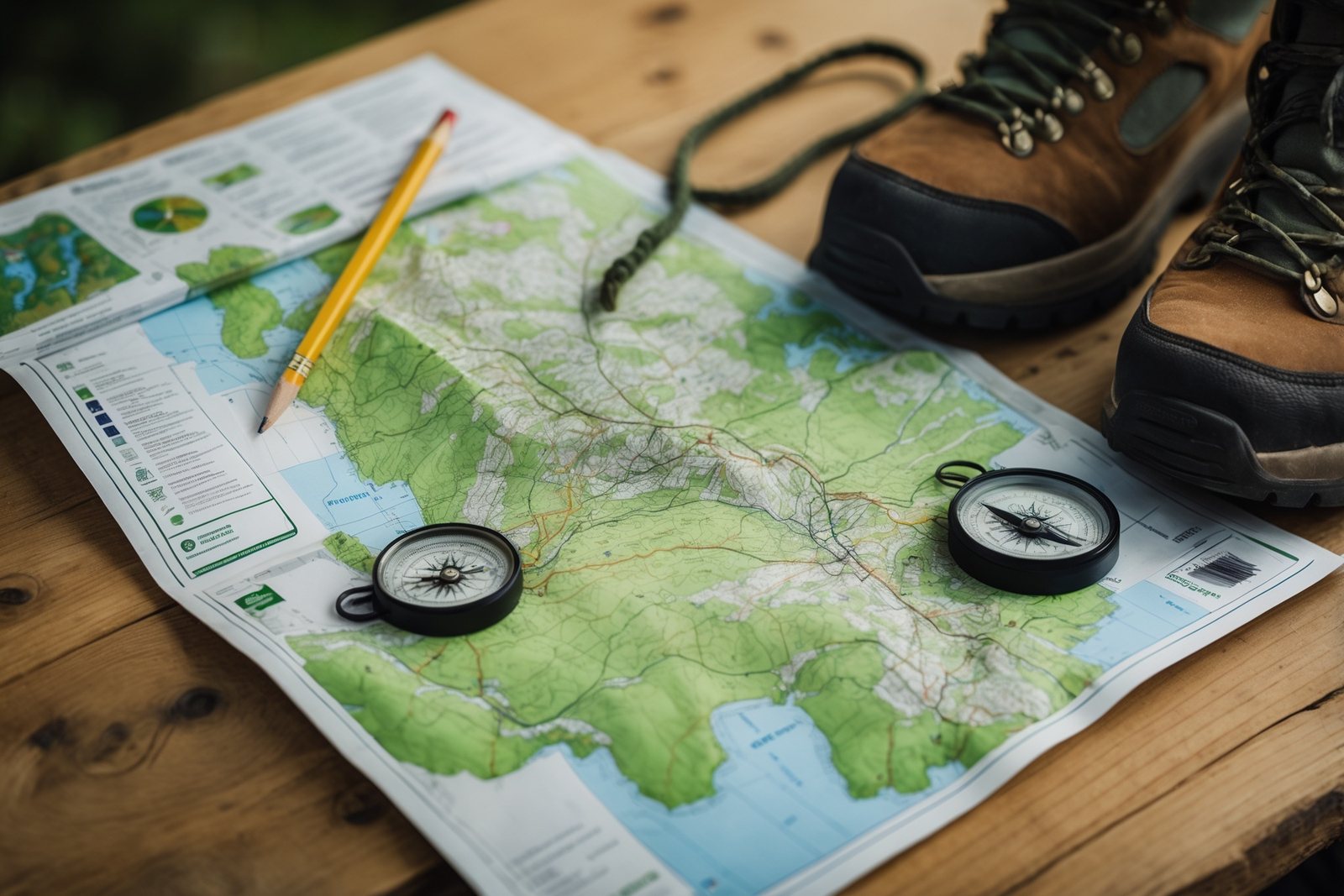
Most people can comfortably walk three or four miles on a Sunday afternoon along a familiar park path or towpath. Stepping up to a ten-mile circular country walk feels like a real milestone. That is not because ten miles demands extreme athletic fitness, but because you are out for five hours across varied fields and tracks.
With twenty minutes of mid-week planning at the kitchen table and a sensible pack, a ten-mile walk is deeply restorative. It lets you link quiet villages, woodland ridges, and river valleys into a proper Saturday journey. A little preparation beforehand ensures you can relax and enjoy the landscape.
Choose the Right Map Scale
Road atlases and standard online street maps leave out the exact details a walker needs outside town. For countryside walking in England, Scotland, and Wales, the benchmark is the Ordnance Survey Explorer series at 1:25,000 scale (the sheets with orange covers).
At 1:25,000 scale, four centimetres on the paper equals one kilometre on the ground. That scale is detailed enough to show every field boundary, hedgerow, stream, footbridge, and contour line. Public rights of way are clearly overprinted in green dashes across the map.
- Short green dashes mark public footpaths, which are legally open to walkers on foot.
- Longer green dashes mark public bridleways, which are open to walkers, horse riders, and cyclists.
Remember that a dotted black line on an Ordnance Survey map only shows a physical path on the ground. It is not a public right of way unless marked with green symbols or crossing mapped open access land.
Estimate Time Using Distance Plus Climb
On flat town pavements, a brisk walker covers three miles in an hour with ease. Across muddy ploughed fields, stone stiles, livestock gates, and hill gradients, your average speed drops closer to two miles per hour.
British walkers use a practical rule of thumb known as Naismith's Rule to estimate journey times. Allow one hour for every three miles (five kilometres) of forward distance, plus thirty minutes for every 300 metres of climb. For a gentle ten-mile lowland walk with modest hills and a half-hour lunch stop, expect to take nearly five hours. In November or December, when dusk falls by four o'clock, set off by nine-thirty so you finish in daylight.
Break the Route Into Short Checkpoints
Instead of trying to follow a ten-mile loop as one continuous line, divide the walk into four or five short legs. Pick unmistakable landmarks on the map — a village church, a canal bridge, or a wood corner — as your checkpoints.
At the start of each leg, check two details on your map before walking. This habit keeps you on course without staring at the map every two minutes:
- Tick-off features along the way: Note what you should pass in order, such as crossing a footbridge after 400 metres.
- A catching feature beyond your turn: Identify a clear line past your turning point, like a lane or railway, that warns you if you walk too far.
Turn your map so the features on the paper line up with the landscape in front of you. If mist drops or paths look unclear among trees, use your compass to align the map with north.
Pack for Five Hours Outdoors
Even when the morning forecast looks dry, British weather changes fast once you are three miles from the nearest road. Wear broken-in boots with wool-blend socks, pack a waterproof jacket with taped seams, and carry water plus substantial food.
Slip a small headtorch, a whistle, blister plasters, and a spare warm fleece into your rucksack regardless of the season. For a complete breakdown of starter gear, rough UK prices, and links to walking charities, see the Walking and Hiking page in our Hobbies Directory.